





Content:
Published: 17.02.2026
Views: 8
If you run a logistics business, there is a high chance that Excel was your starting point. You recorded orders in spreadsheets, discussed statuses in messengers, and kept financial data in a separate file. At first, this is a convenient and clear solution that lets you quickly organize operations. However, as your business grows, the need to automate logistics processes becomes obvious. It is no longer enough to simply store data; you need to see the full picture: who is responsible for fulfilling an order, what stage it is at, and where delays occur. Without a unified system, control gradually shifts into manual mode and requires constant involvement from the business owner.
This challenge reflects the broader transformation of the logistics industry. According to Data Insights Market, the Transportation & Logistics CRM Software market reached $4.075 billion in 2025 and is projected to grow at a CAGR of 6.9% through 2033. The main drivers of this growth are the need to improve efficiency, reduce manual work, and gain better control over processes. The shift to cloud-based CRM solutions and the integration of analytics and AI enable data-driven decision-making, making the move away from Excel a necessary step toward building a scalable and well-structured logistics management system.
In this article, the Asabix team explains why transitioning from Excel to a CRM is a logical step for a growing logistics business and how to plan this transition so that your system actively supports your company's long-term growth.
The First Turning Point: When You Stop Understanding What’s Happening in Operations
Problems with Excel in logistics can be described as a gradual loss of control. The data seems to be there, and the workflow formally exists, yet answering simple management questions becomes increasingly difficult. Several warning signs usually appear first:
- Data from different files contradict each other, and verifying accuracy takes time.
- It becomes difficult to quickly determine the status of a specific order, requiring cross-checking spreadsheets, messages, and verbal agreements.
- Accountability is unclear: responsibility is assigned ad hoc instead of being defined by the process.
As a result, you lose the ability to see the full picture. The core issue lies in the limitations of the tool itself: Excel does not support process logic. This leads to systemic breakdowns:
- There is no single source of truth, as data is scattered across files, versions, and individuals.
- It is impossible to reconstruct the decision chain because changes are not properly logged or attributed.
- Errors are not detected systematically; they only become visible once they have already affected results.
- Analytics is generated manually, making fast response and strategic planning more difficult.
This situation is not unique to individual companies. Today, around 32% of small businesses in the UK still rely on spreadsheets as their primary tool for managing customer and operational data. At the same time, companies that implement CRM systems report an average 29% increase in sales and a 34% improvement in team productivity, clearly highlighting the systemic nature of issues caused by manual management.
So, this is where the logical question comes in: how exactly does CRM as an enterprise logistics software change the approach to managing logistics? Let’s examine this in detail.
CRM in Logistics: What Will Actually Change in Your Daily Operations
CRM in logistics is not just another data storage system. For your business, it transforms how operations are managed: instead of spreadsheets, scattered messages, and manual oversight, you get a unified process logic that works regardless of who is involved at any given moment. You can clearly see what has already been completed and what the next step should be. Let’s look at the key areas where CRM delivers the greatest impact.
- Manage orders as structured objects with a clear lifecycle In a CRM, an order is no longer a fragment of information scattered across spreadsheets, chats, and files. It becomes a structured object with defined parameters: status, responsible person, change history, and next actions. You no longer see just the existence of an order; you see its actual position within the execution process. Every action related to the order is logged in the system, so context is never lost when the task is transferred between employees or departments. This significantly reduces dependency on verbal agreements and individual memory.
- Define clear statuses and control points CRM allows you to describe logistics as a sequence of clearly defined stages. Each status reflects a specific operational condition, and transitions between statuses follow established rules. Control points help identify where delays occur and at which stage the process deviates from planned timelines. For the business, this replaces chaotic follow-ups with a structured and transparent execution framework.
- Gain operational control without constant intervention With CRM, control stops being manual. You no longer need to check tasks daily or interfere in workflows just to understand whether everything is on track. The system automatically highlights deviations, overdue actions, and overloaded areas. This changes the manager's role: instead of running on tribal knowledge, you work with real-time data and signals that reveal issues early. The result is freed-up management time and the ability to focus on strategic growth rather than routine supervision.
- Ensure transparent communication with clients CRM centralizes all information related to client interactions: order statuses, agreements, documents, and communication history. This allows your team to provide accurate, up-to-date information without internal clarification loops. Transparency reduces the number of status-related inquiries and increases client trust by making responses consistent and data-driven.
- Build a real-time financial overview CRM connects operational data with financial indicators. You can see planned versus actual figures, costs, and revenue by route or direction, and clearly understand which processes generate profit and which require adjustment. Financial data is no longer a separate end-of-period report; it becomes part of daily management.
- Use analytics to drive decisions CRM analytics shows not only results but also the underlying causes behind them. You can track how efficiency changes over time and identify recurring bottlenecks. This enables decisions based on real data rather than assumptions. CRM becomes a tool for systematic logistics optimization, allowing you to continuously improve performance and strengthen overall business efficiency.
Moving from Excel to CRM: How to Organize the Transition Effectively
Switching from Excel to a CRM system in logistics is not simply about replacing one tool with another. It is about changing the way you manage responsibilities and data. The outcome depends less on which CRM you choose and more on how structured and deliberate your transition process is. Below are the key steps that make implementation controlled and predictable.
Build a Structured Process Logic Instead of Copying Spreadsheets
One of the most common mistakes is attempting to transfer Excel into CRM without rethinking the logic behind it. Spreadsheets store data, but they do not define workflows. CRM systems, on the other hand, operate through objects, states, and transition rules. Directly copying the Excel structure into CRM often results in a confusing, inefficient system. At this stage, it is crucial to redefine the core objects within your logistics operations: orders, shipments, clients, documents, and financial transactions. For each object, you need to determine which actions are allowed, the sequence of stages, and the conditions under which transitions occur. This approach cuts duplication, inconsistent scenarios, and manual workarounds that have accumulated in spreadsheets over time. Instead of recreating old inefficiencies in a new system, you build a clear operational architecture that supports scalability and stability.
Prepare and Standardize Data Before Migration
The effectiveness of a CRM system depends directly on the quality of its data. Transitioning from Excel provides an ideal opportunity to audit and clean your information. If you skip this step, errors from spreadsheets will simply carry over into the new system, affecting analytics and decision-making. Before migration, review contacts, orders, and financial records. Remove duplicates, update outdated entries, and standardize formats for dates, statuses, currencies, document numbers, and key reference fields. Historical data should also be evaluated critically; not everything stored for years needs to be transferred. The cleaner and more structured your data at launch, the faster your enterprise logistics analysis tool will start delivering meaningful analytics and clarity.
Launch CRM with Core Processes and Expand Gradually
Effective implementation does not start with full functionality. It begins with the processes that carry the greatest operational load and require the most manual control. Focusing on these core scenarios enables the team to adapt more quickly and deliver immediate practical value. Automating key areas (warehouse, order management, task coordination, logistics workflows) instead of relying on manual Excel scenarios can reduce costs by 20-60% and increase efficiency by up to 50% by eliminating duplication, data loss, and unsynchronized actions between teams. At the initial stage, it makes sense to concentrate on a limited set of processes, such as:
Order and status management;
- Responsibility assignment between roles;
- Basic deadline tracking;
- Initial analytics.
- This phased approach allows you to test system logic in real conditions and refine it before expanding complexity. Gradual scaling reduces team overload and makes implementation more predictable.
Explain to the Team How CRM Supports Daily Work
Even the most advanced software solutions in a logistics enterprise will fail if the team perceives it as a control mechanism or additional workload. During implementation, the focus should be on how the system simplifies daily tasks and reduces routine friction. Training should be based on real-world scenarios that the team encounters every day. In particular, employees must clearly understand:
How to create mandatory fields and why they matter;
- Which fields are filled manually and which are automated;
- When and how to change the status of a deal or order;
- Where to find and manage new leads;
- How to create, update, and configure records correctly;
- How the pipeline is structured and how it functions;
- How to segment the database for daily work;
- How to send email campaigns without duplication;
- How to assign tasks and track execution;
- How reports are generated and forecasts calculated;
- When employees understand how CRM removes ambiguity and reduces repetitive work, adoption becomes consistent and sustainable.
Collect Feedback and Evolve CRM Together with the Team
CRM implementation does not end at launch. Real-world usage inevitably reveals nuances that cannot be predicted during the design phase. Regular team feedback becomes essential for long-term effectiveness. By identifying inconvenient steps, redundant actions, or unclear logic, and adjusting them within the broader business objectives, you gradually transform CRM into a stable enterprise logistics management tool. Continuous improvement ensures that the system evolves alongside your company rather than becoming another rigid structure that limits growth.
When Standard CRM Systems Are Not Enough and You Need a Custom Web Solution
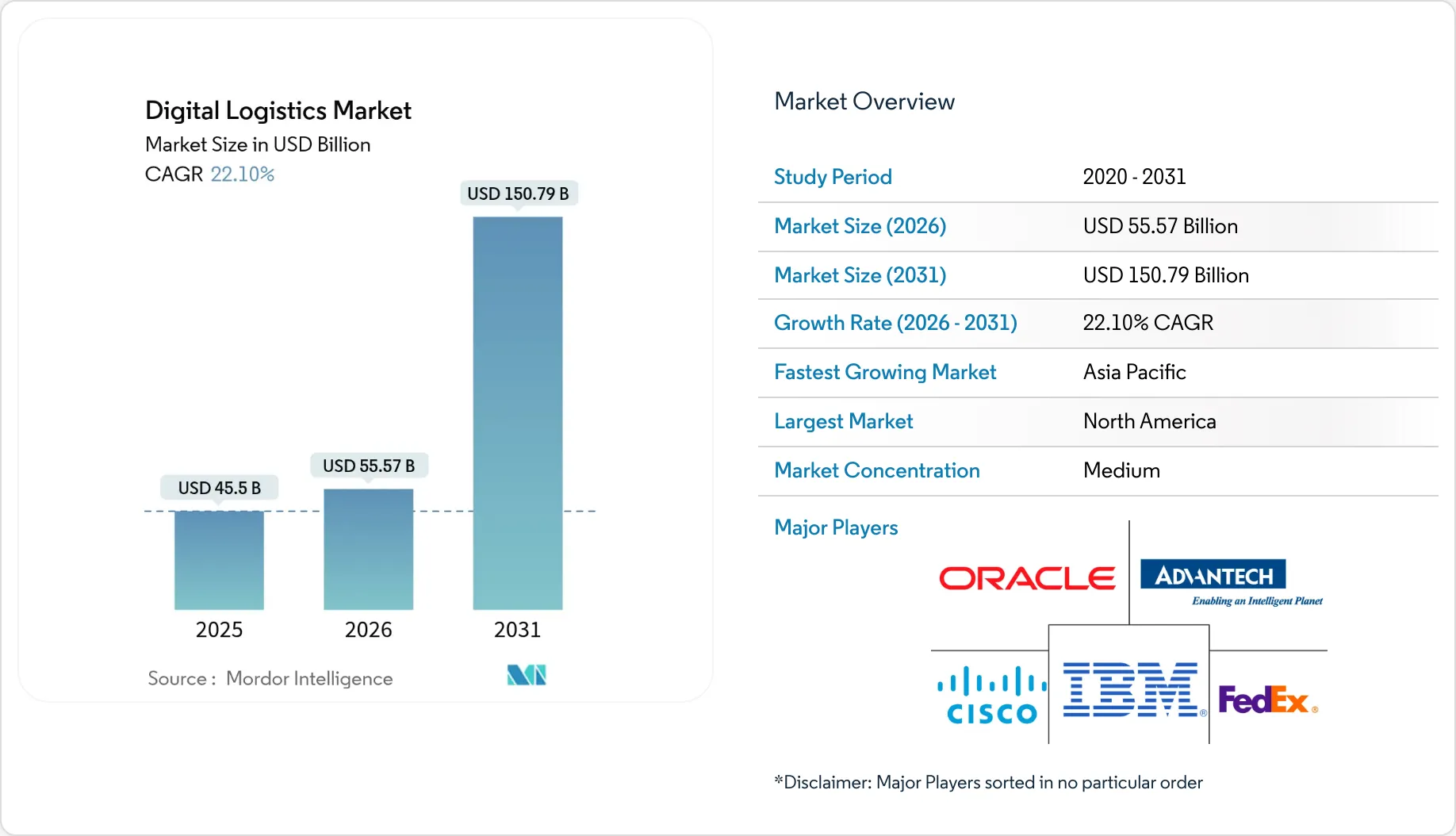
Standard CRM systems perform well in typical business scenarios. However, in transport and warehouse logistics, typical processes are rare. As soon as a company moves beyond basic workflows, off-the-shelf solutions begin to require compromises: additional modules, complex configurations, or manual workarounds that gradually undermine the very purpose of automation. These limitations become even more visible in the context of broader digital transformation. The digital logistics market is projected to grow from $55.57 billion in 2026 to $150.79 billion by 2031, with a CAGR of 22.1% so in such an environment, flexibility, scalability, and architectural resilience are strategic requirements.
The first signs that a standard CRM no longer meets your needs are usually clear. You may introduce complex routing logic with multiple rules, stage dependencies, and exceptions within workflows. Your team structure evolves beyond the traditional “manager-supervisor” model and now includes dispatchers, coordinators, financial controllers, and partners with limited access rights. On top of that, integrations with accounting systems, warehouse software, GPS tracking, document management platforms, or customer portals become critical. Under these conditions, the CRM system becomes increasingly complicated, harder to maintain, and less intuitive for users. Instead of supporting operations, it starts constraining them.
A custom CRM addresses these optimization and logistics challenges in the enterprise in a different way. Warehouse and transport logistics processes are designed around your operational model, not forced into a generic template. Scalability is built into the architecture, ensuring the system does not break as the business grows. For the team, such a CRM is easier to use because its interface and workflows reflect real operational scenarios. As a business owner, you understand how the system will behave when volumes increase, new routes are added, or processes change. Control remains structured and independent of team size, and the CRM evolves together with the company rather than becoming a bottleneck.
A strong example of this approach is the development of a high-load CRM for the logistics company SkladUSA. The business handles large volumes of orders, employs complex workflow logic, and requires strict system stability. In this environment, standard CRM solutions could not provide the necessary performance or flexibility. Instead of adapting an off-the-shelf product to its limitations, the Asabix team designed a custom web platform tailored to the company’s actual processes, accounting for high concurrent user counts, significant data volumes, and the need for instant access to the current status of every order. As a result, the system became the operational core of the business, capable of scaling alongside company growth.
At this stage, technology alone is not enough; experience matters. The Asabix team develops custom CRM and web systems for businesses with complex operational logic that standard solutions fail to deliver. We start with a deep analysis of real workflows, design the architecture around specific business tasks, and embed scalability from the very beginning. From our experience, CRM development delivers value only when the system is built around actual routes, roles, and control points.
You may also be interested in: Logistics: everything from website to CRM system
Final Thoughts
Excel is not inherently the wrong choice. For many logistics companies, relying on spreadsheets was a logical starting point: it helped structure requests, launch workflows, and support early growth. But this approach has limits. As the business scales, Excel stops being a neutral tool and begins to affect manageability. The issue is no longer the number of files or the complexity of the formulas – it is that control relies on manual checks, phone calls, and the constant involvement of the owner or logistics manager in enterprise resource planning daily. At that stage, operational control becomes heavily dependent on individual oversight rather than system logic.
In this context, CRM represents a transition to a mature management model where processes follow clear logic, responsibilities are defined, and decisions are data-driven. CRM restores transparency, removes manual control, and creates a foundation for scalable growth without chaos. If you are constantly pulled into operational issues, lack real-time visibility, or feel that further growth brings more risk than opportunity, what you need is not another spreadsheet but logistics CRM development services. The Asabix team develops custom CRM and web solutions tailored to logistics businesses with complex operational structures. We design systems around real workflows and build solutions that grow alongside your company. Contact us to discuss your case and determine which CRM will best support your business.
Let's discuss your project
Blog
#0000
Read more articles in our blog
What is PWA: Comprehensive Guide with Code Samples
26 Feb, 2024
Progressive Web Apps are web applications that bring best web and mobile features. PWAs are similar to native apps in functionality and can be used on any device with a web browser.
VIEW ARTICLE
-compress.jpg "From Excel to CRM: Transforming Logistics Processes Through Modern Web Solutions - Picture №5")
Outsourcing and outstaff: difference and features
20 Jul, 2023
Modern companies often have a need for fast and efficient development of software and other IT projects.
VIEW ARTICLE

Website Development Costs: What to Expect
08 Jan, 2025
Are you curious about the cost of creating a website? Discover how design intricacies, advanced functionality, and the type of site you envision can impact your budget.
VIEW ARTICLE
Why Do You Need a CRM System: Definition, Benefits, and Types
22 Feb, 2024
CRM is software for automating and managing customer interactions. Here, all data about the history of orders and sales, about each customer and his preferences, as well as about previous interactions of the brand with the consumer, are stored electronically.
VIEW ARTICLE
