




Content:

Published: 21.01.2026
Views: 758
Customer loyalty in B2B markets is rarely driven by emotions or brand image. What truly influences the decision to work with a supplier is how convenient, secure, and predictable day-to-day operations are. The data backs this up: 83% of B2B buyers prefer placing orders digitally, and 39% are willing to complete online transactions worth $500,000 or more. In other words, digital channels are already seen as reliable, even for large, business-critical deals.
Against this backdrop, traditional retention tools such as bonuses, discounts, or loyalty programs stop working unless they are supported by a robust digital infrastructure. They may encourage individual purchases, but they do not create lasting, structural customer attachment. In B2B, clients stay where:
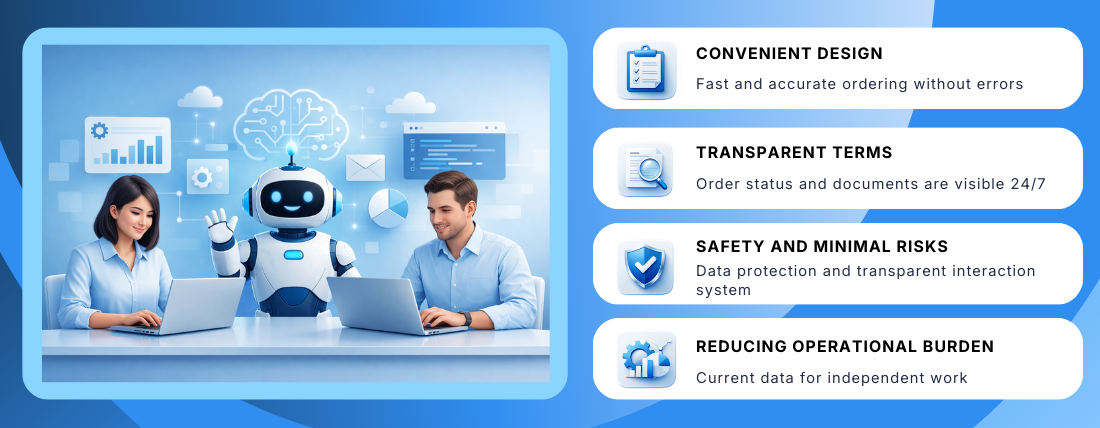
- orders can be placed quickly and without errors;
- commercial terms are transparent and not tied to a specific person;
- the system reduces operational workload for their team;
- the risk of disruptions and conflicts is minimized.
This is why the B2B platform itself becomes a core driver of loyalty. It defines how easily a client can repeat an order, track statuses, access documents, analyze purchasing history, and justify decisions internally within their organization. In this article, we’ll examine which B2B platform capabilities genuinely influence customer retention, reduce churn, and increase long-term LTV.
What Loyalty Really Means in B2B: The Economics of Customer Retention
Customer loyalty in B2B is often mistakenly seen as the result of strong personal relationships or the sales team's performance. In reality, loyalty is an economic concept that directly affects revenue, margins, and overall business stability. That is precisely why it cannot be achieved without structured digital systems.
Let’s start with the fundamentals. Industry research shows that around 60% of B2B revenue comes from repeat customers rather than new deals. At the same time, acquiring a new B2B customer costs, on average, 75% more than retaining an existing one. In practical terms, every lost customer creates double financial pressure: the business loses future revenue and must invest significantly more resources to offset that loss. Even more revealing is the impact of small improvements in retention. Analytics consistently show that a 5% increase in retention can lead to a 25–95% increase in profit. This disproportionate effect is explained by the fact that loyal customers place orders more frequently, increase average order value, require less manual support, and generate far fewer operational conflicts.
At the same time, it’s important to understand that in B2B, loyalty is rarely the result of brand preference. In most cases, it is an operational dependency. This dependency emerges when a supplier is deeply embedded in the client’s processes. Switching suppliers stops being a simple decision when the platform:
- stores purchase history;
- automates repeat orders;
- displays personalized prices and terms;
- provides transparency across statuses and documentation.
In B2B, loyalty often takes the form of a rational decision to avoid creating new problems. Once a client becomes accustomed to the predictability, control, and speed delivered by a platform, any alternative that lacks comparable functionality is automatically perceived as a step backward. From this perspective, a B2B platform should be viewed not as a sales tool, but as a core mechanism for customer retention and revenue scalability.
A B2B Platform as a Customer Retention Mechanism, Not Just a Sales Channel
In many B2B companies, digital tools are still viewed in isolation: CRM for sales, ERP for accounting, email for communication, and the website for branding. The problem is that none of these tools, on their own, builds customer loyalty because they fail to create a unified operational experience. From the client’s perspective, the picture looks very different. What matters is not the supplier’s internal automation, but a few practical questions:
- Can I place an order quickly?
- Do I see up-to-date prices and terms?
- Do I understand the delivery status?
- Can I repeat the transaction without unnecessary back-and-forth?
When answers to these questions are scattered across emails, spreadsheets, and calls with account managers, the platform fails at its core task: reducing the client’s operational burden. This is the point at which a B2B platform moves beyond being a sales channel and becomes a customer retention mechanism. It brings together, in a single environment:
- orders and repeat purchases;
- personalized pricing and catalogs;
- document management;
- communication;
- client-facing analytics.
The key shift is that the platform transfers complexity from the client to the system. Instead of remembering contract terms, coordinating with multiple people, or manually verifying data, the client operates within a controlled, predictable process. That predictability becomes the foundation of loyalty. It’s also important to recognize that a B2B platform creates what can be described as “silent” loyalty. Clients may not consciously think of themselves as loyal, but they:
- consider alternatives less frequently;
- postpone switching suppliers “for later”;
- concentrate a larger share of purchases within a single system.
That’s why companies that invest in B2B platform functionality don’t just achieve better UX. They also see lower churn and higher long-term LTV.
Loyalty in Motion: How a B2B Platform Supports the Customer Across the Lifecycle
In B2B, loyalty doesn’t emerge at a single point in time. It is built or lost across different stages of the relationship, with clients continuously evaluating suppliers through the lens of risk, convenience, and process predictability. That’s why a platform must support the client throughout the entire customer lifecycle. So, how to build customer loyalty in B2B? Let's break it down.
- Onboarding and the first order
The first interaction with the platform sets the tone for everything that follows. If a client encounters a confusing interface, manual approvals, or complete dependence on an account manager from the outset, the risk of early churn rises sharply. At this stage, the platform should enable the client to quickly and independently review the catalog and terms, place an order, and receive confirmation without delays. - Ongoing operations and repeat orders
When a client moves from a one-off purchase to recurring transactions, even minor inconveniences begin to scale: extra emails, repeated clarifications, and manual checks. Research shows that 79% of B2B buyers prefer placing repeat orders online rather than through managers. If the platform allows clients to:- repeat orders in just a few clicks;
- view purchase history;
- work with personalized prices and terms,
- they increase transaction frequency and think less often about alternative suppliers.
- Customer growth and scaling
As a client’s business grows, interactions become more complex. New users and roles appear, purchasing volumes increase, and internal approval workflows expand. If the platform doesn’t support scaling, processes quickly revert to manual mode. At this stage, loyalty is preserved only if the platform automatically adapts to growing volumes, supports role-based access control, maintains transparency and control without sacrificing speed. - Crisis situations and incidents
Crises are where loyalty is truly tested. Delivery delays, documentation errors, or financial discrepancies are inevitable in B2B relationships. The key difference lies in whether the client has a transparent way to monitor what’s happening. When the platform shows real-time statuses, change history, and clear ownership, even an issue doesn’t feel like a critical risk. When clients are forced to chase information through calls and emails, trust erodes very quickly.
You may also be interested in: Top 5 Features a Modern B2B Portal Must Have in 2026
Key Loyalty Mechanisms in B2B Platforms
Loyalty is a direct result of how convenient, predictable, and controlled it is for a client to work with a supplier in everyday operational processes. Below, we examine the core functional mechanisms of B2B platforms that directly influence customer retention.
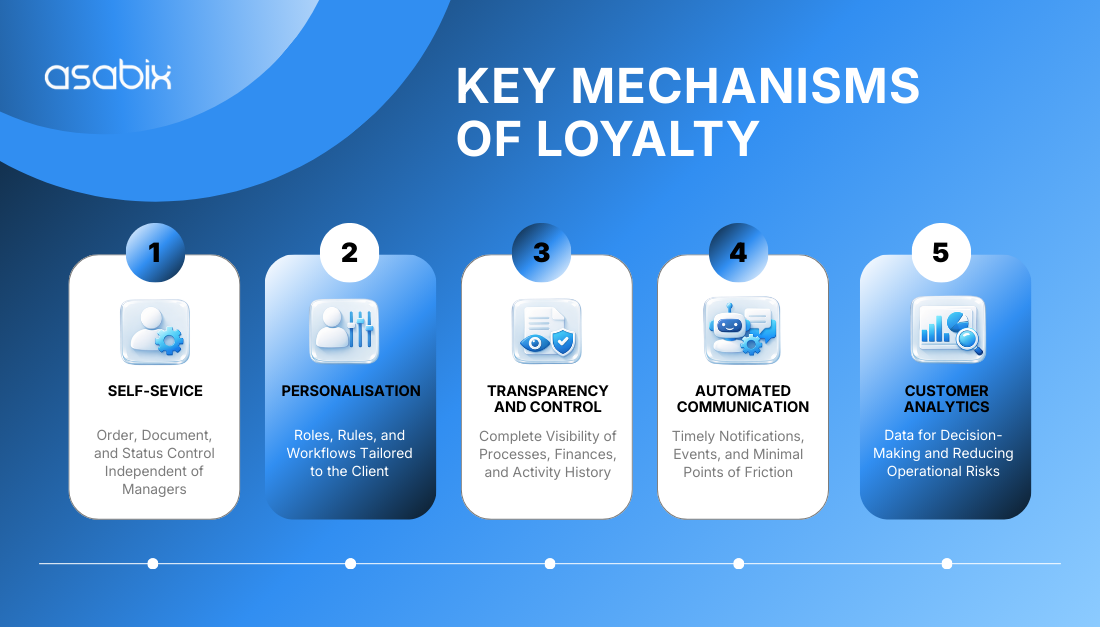
Functionality №1: Self-Service as the Foundation of Operational Loyalty
In modern B2B, self-service is a baseline expectation for customer loyalty. Without it, a platform simply fails to meet market standards. B2B buyers increasingly expect at least partial self-service during the purchasing process, and most explicitly prefer it over interacting with a sales representative. These expectations are closely tied to business outcomes and clearly signal that self-service has become a core factor in competitiveness and customer retention.
In practice, B2B self-service consists of a set of concrete operational scenarios, including:
- independent access to personalized catalogs and pricing;
- fast reordering of previous purchases;
- visibility into order statuses, invoices, and documents;
- minimal dependence on a specific account manager.
A typical workflow looks like this: a procurement specialist logs in to the platform, reviews the order history, repeats a required item, downloads the invoice, and forwards it to the finance team without making calls, sending emails, or requesting follow-up clarifications. For the client, this saves time; for the supplier, it reduces operational costs and the number of error points. Real-world examples support this. Filtrous tripled its order frequency after implementing a B2B self-service platform, reducing manual work by approximately 12 hours per week. Another example is Kulani Kinis, which achieved a threefold increase in wholesale customers after launching a simple, easy-to-use B2B store.
Importantly, self-service influences loyalty not only through convenience but also by reducing risk. When clients control the process themselves, they rely less on human intervention, encounter fewer errors, and make decisions faster. This creates a sense of stability – something far more valuable in B2B than bonuses or discounts. Conversely, the absence of self-service almost inevitably leads to the opposite outcome: increased load on account managers, more ordering errors, and clients actively seeking alternatives with a simpler, more transparent digital experience.
Functionality №2: Personalization as Embedded Business Logic, Not Marketing
In B2B, personalization is often confused with marketing tactics such as product recommendations, personalized banners, or email campaigns. The problem is that this kind of personalization has little impact on loyalty if it isn’t embedded into the client’s operational workflows. True B2B personalization starts with commercial terms, and the numbers back this up. Research shows that 77% of B2B buyers won’t complete a purchase without a personalized experience, and effective personalization can increase revenue by up to 1.4×.
What sets this type of personalization apart is that it removes the need for manual agreements. Clients don’t have to clarify terms over email or remember which pricing applies to them. The platform automatically applies business rules and displays the correct information at any given moment. For example, WHO IS ELIJAH implemented custom pricing matrices across eight geographic regions within its B2B platform. As a result, international wholesale revenue grew by 50% year over year without a commensurate increase in the sales team's workload.
From a loyalty perspective, personalization acts as a form of “soft lock-in.” When a platform consistently reflects familiar pricing, enforces internal purchasing rules, and automatically adapts to changing volumes, switching suppliers becomes more than just changing a catalog. It requires rebuilding the entire interaction logic from scratch. This significantly increases switching costs and reduces churn risk, even when alternative offers exist in the market.
Functionality №3: Transparency and Control as the Foundation of Trust
A client may forgive an occasional mistake or delay, but almost never the lack of control or information. Transparency is one of the key drivers of long-term loyalty. Research shows that B2B buyers are more likely to work with companies that genuinely understand their goals, yet most clients believe sales representatives don’t pay enough attention to this. In other words, even with an active sales contact, clients often don’t feel real control over what’s happening.
A B2B platform compensates for this human factor. Transparency in a digital environment means the client can see, at any time:
- the current status of orders, payments, and deliveries;
- change history and responsible parties;
- all related documents in one place;
- the real state of the process without “I’ll check and get back to you.”
When this information is available in real time, trust no longer depends on a specific account manager. The client works with facts recorded in the system, not with promises.
Transparency becomes especially critical during crisis situations. Delivery delays, logistics disruptions, or financial discrepancies happen even in mature organizations. The difference between retained and lost loyalty comes down to whether the client can independently track what’s happening, understand the root cause, and see what actions are already underway to resolve the issue. Without this level of control, clients are forced to chase information through calls and emails, which creates tension and a sense of chaos.
From a business-impact perspective, transparency directly strengthens loyalty by:
- reducing the number of conflicts and escalations;
- shortening incident resolution times;
- lowering dependency on individual employees;
- shifting trust from specific people to the system itself.
Functionality №4: Automated Communication as a Customer Retention Tool
In many B2B organizations, client communication is still built around email, messengers, and manual reminders. The issue isn’t the channels themselves, but the fact that they don’t preserve process context. Information becomes fragmented, accountability blurs, and clients are forced to piece together the full picture on their own. As a result, tension increases and trust declines, even when the business is technically meeting its obligations.
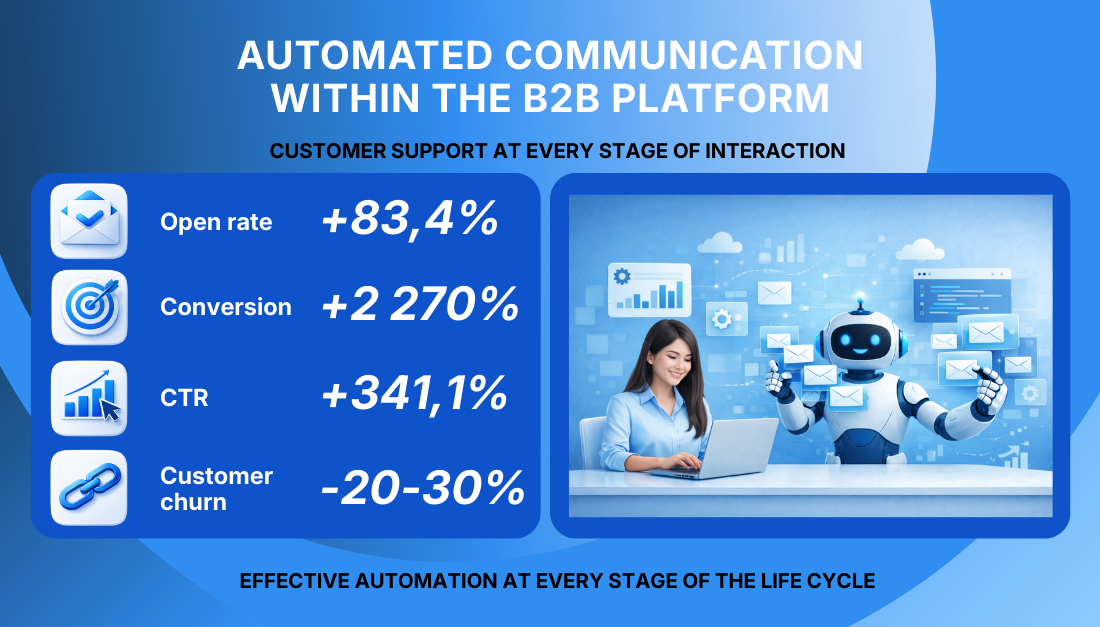
Automated communication within a B2B platform works differently. It systematically supports the client at every stage of the interaction, capturing events and responses within a single process. Research shows that automating communication across the customer lifecycle:
- increases open rates by 83.4%;
- boosts click-through rates by 341.1%;
- improves conversion rates by 2,270%;
- reduces churn by 20-30% compared to broadcast-style approaches.
The key point is that automated communication in B2B is not about mass messaging. It consists of system-driven notifications tied to specific actions and statuses, such as order confirmations, stage changes, document readiness, shipment updates, or incident resolution. Clients receive information exactly when they need it and within the context of a specific process.
Equally important, automated communication directly strengthens loyalty through predictability. When clients know the system will proactively notify them of any changes, anxiety decreases. This is especially critical in B2B environments with long fulfillment cycles and complex logistics. When communication remains fragmented, the opposite effect occurs: the number of clarifications, internal escalations, and “unnecessary” touchpoints grows over time, gradually eroding loyalty. Clients may continue working with the supplier, but trust weakens, and the willingness to scale the relationship declines.
Functionality №5: Client-Facing Analytics as a Tool for Retention and Internal Justification
In many B2B platforms, analytics is treated solely as a supplier-side tool: management reports, sales forecasting, performance monitoring. From a loyalty standpoint, however, client-facing analytics is far more critical. It determines whether the client can justify working with a supplier inside their own organization.
This ties directly to the economics of retention. Research shows that retained customers generate nearly half of a company's annual revenue when loyalty is approached systematically. The value isn’t limited to repeat purchases; these clients also integrate the supplier into their own planning and control processes.
From the client’s perspective, analytics serves several practical purposes:
- preparing reports for internal stakeholders;
- planning budgets and procurement;
- comparing actual spend against planned figures;
- explaining variances and decision-making.
In practice, B2B clients tend to value not complex BI dashboards, but reliable, straightforward analytics: purchase history over a given period, trends in order volume and frequency, average order value and its changes, and deviations from established purchasing patterns.
How to Measure the Impact of B2B Platform Functionality on Customer Loyalty
In practice, loyalty reveals itself through customer behavior and operational metrics that directly reflect how deeply the platform has become embedded in a client’s processes. The first measurement layer is behavioral metrics. These show how clients actually use the platform:
- repeat order frequency;
- share of orders placed via self-service;
- average time between purchases;
- percentage of clients actively using key features (account area, analytics, documents).
Growth in these indicators signals that the client isn’t just “registered,” but operationally tied to the system. This kind of attachment is what drives long-term loyalty.
The second layer consists of operational metrics, which are often underestimated. They indicate how effectively the platform reduces workload and risk:
- fewer manual requests to sales or support;
- shorter order processing times;
- fewer errors and claims;
- faster incident resolution.
These metrics create a dual effect. On the one hand, they lower supplier costs. On the other hand, they give clients a sense of stability and predictability, directly influencing their willingness to continue the partnership.
The third layer is financial metrics, which translate loyalty into measurable value:
- customer lifetime value (LTV);
- share of revenue from repeat customers;
- cost-to-serve per client;
- average order value trends over time.
According to the Antavo Global Customer Loyalty Report 2024, 9 out of 10 companies (90%) report a positive ROI from loyalty programs. The average ROI is 4.8×, with some sources reporting up to 5.2×. In other words, these programs generate 4.8–5.2 times more revenue than they cost, making properly measured loyalty not an expense, but an investment with predictable returns.
It’s also important to be cautious with universal metrics like NPS. In B2B, a high NPS doesn’t always equal real loyalty. A client may be satisfied, yet still:
- place orders infrequently;
- avoid scaling the relationship;
- actively test alternative suppliers.
That’s why the most reliable indicator of B2B loyalty isn’t a score, but behavior within the system. If a client consistently uses the platform, automates their processes through it, and increases the share of operations within a single digital environment, that’s the strongest signal of long-term retention.
You may also be interested in: 5 Reasons Why a Website Without Marketing Functionality Wastes Your Advertising Budget
Common Mistakes That Destroy Loyalty in B2B Platforms
Most loyalty issues in B2B don’t stem from a lack of budget or technology – they come from flawed assumptions made during the platform design stage. As a result, companies invest in digital solutions that technically work but fail to deliver real operational value to customers.
- Mistake №1: Copying B2C Logic
In B2C, speed of purchase and emotional UX are critical. In B2B, clients care about different things: control, predictability, and alignment with internal rules. When a B2B platform is built on B2C principles (minimal configuration, generic workflows, simplified pricing), it quickly runs into the realities of contracts, roles, and complex approvals. This gap between expectations and functionality directly drives customer churn. - Mistake №2: Focusing on the Interface Instead of the Processes
Good design alone does not create loyalty if it masks manual checks, inconsistent statuses, and dependence on account managers. Clients may appreciate UX at first glance, but they stay only when the platform works reliably in day-to-day operations. That’s why platforms that look modern yet fail to automate core workflows often fall short on retention. - Mistake №3: Ignoring Client-Side Roles
In B2B, decisions are not made by a single person. Procurement, finance, and leadership view the platform from different perspectives. If the system doesn’t support role-based access, analytics, and permissions, clients are forced to compensate with manual processes. Over time, this creates overload and reduces willingness to scale the relationship. - Mistake №4: Lack of Platform Evolution
Even a well-designed B2B platform loses value if it doesn’t evolve alongside the client’s business. Customers expect the platform to scale and support growth, not become a constraint.
All of these mistakes lead to the same outcome: clients don’t leave immediately, but gradually reduce volumes, test alternatives, and eventually switch when a critical moment arrives. That’s why building loyalty in B2B doesn’t start with “better service,” but with the right platform architecture – one that’s grounded in the client’s real operational processes.
Who Should Design a B2B Platform Focused on Customer Retention and How
A B2B platform that truly retains customers never starts with design or a feature checklist. It starts by answering a few fundamental questions:
- how the client actually works day to day;
- where they lose time, control, or information;
- which decisions they have to “defend” internally;
- which risks are critical for their business.
That’s why designing a B2B platform is always a combination of business analysis, process thinking, and technical architecture. The team needs to understand not only technology, but also procurement logic, financial constraints, role-based models, growth scenarios, and crisis situations.
In practice, this approach is delivered by teams operating at the intersection of consulting and engineering. For example, in its B2B projects, Asabix starts with a deep analysis of the client’s business processes: how orders are created, where errors occur, and which interaction points generate friction or loss of control. This makes it possible to design the platform not as a standalone digital product, but as an integral part of the client’s operational system.
Conclusion: Loyalty in B2B Is a Measurable Outcome of a Well-Designed System
The results of building customer loyalty in B2B rarely show up in visible or emotional ways. More often, it reveals itself through behavior: clients place orders more frequently, contact support less, expand the scope of cooperation, and postpone searching for alternatives. All the examples and data above point to one clear pattern: loyalty is a byproduct of a properly designed platform. Self-service reduces operational costs and dependence on people. Personalization stabilizes long-term relationships. Transparency and automated communication lower conflict and risk. Analytics enables clients to justify the partnership within their own organizations.
When more than 60% of revenue comes from repeat customers, and even a 5% increase in retention can drive up to a 95% increase in profit, loyalty stops being a marketing concept. It becomes a strategic business asset, one that cannot be built without a systematic approach to the digital platform itself. That’s why B2B portal developmentabix is increasingly viewed not as an IT project or an extra sales channel, but as an investment in the foundation of long-term customer relationships. And the approach of designing a platform into the client’s business processes, as Asabix does in its B2B solutions, is no longer the exception but the new market standard.
Let's discuss your project
Blog
#0000
Read more articles in our blog
What is PWA: Comprehensive Guide with Code Samples
26 Feb, 2024
Progressive Web Apps are web applications that bring best web and mobile features. PWAs are similar to native apps in functionality and can be used on any device with a web browser.
VIEW ARTICLE
-compress.jpg "How to Increase Customer Loyalty Through B2B Platform Functionality - Picture №6")
Outsourcing and outstaff: difference and features
20 Jul, 2023
Modern companies often have a need for fast and efficient development of software and other IT projects.
VIEW ARTICLE

Website Development Costs: What to Expect
08 Jan, 2025
Are you curious about the cost of creating a website? Discover how design intricacies, advanced functionality, and the type of site you envision can impact your budget.
VIEW ARTICLE
Why Do You Need a CRM System: Definition, Benefits, and Types
22 Feb, 2024
CRM is software for automating and managing customer interactions. Here, all data about the history of orders and sales, about each customer and his preferences, as well as about previous interactions of the brand with the consumer, are stored electronically.
VIEW ARTICLE
