




Content:

Published: 06.08.2026
Views: 406
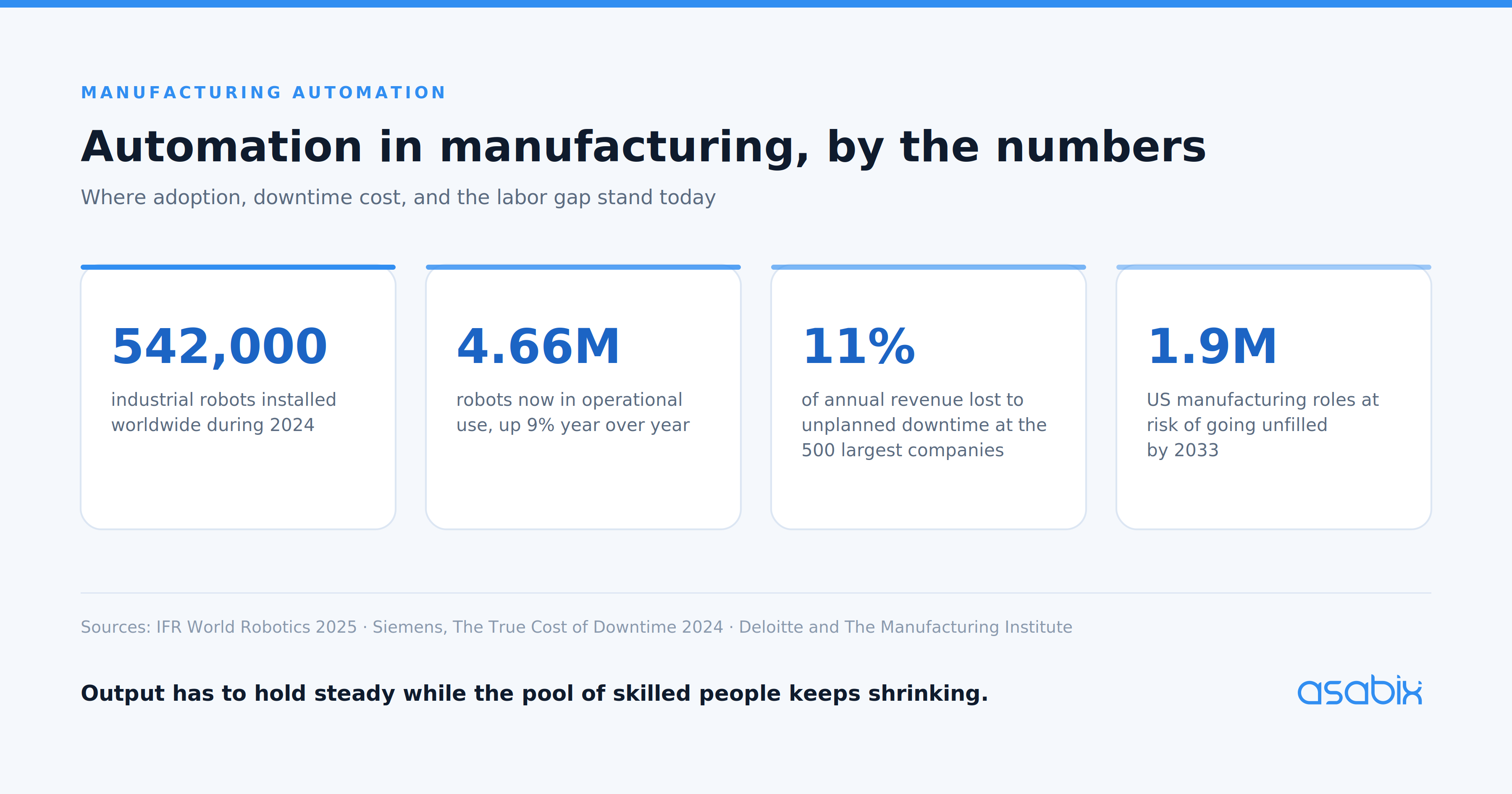
Factories around the world installed 542,000 industrial robots during 2024, bringing the global operational stock to roughly 4.66 million units, according to the IFR's World Robotics 2025 report. Hiring numbers tell a very different story. Deloitte and The Manufacturing Institute estimate that US manufacturers may need 3.8 million additional workers by 2033, and about 1.9 million of those roles are at risk of staying unfilled.
Put those two figures side by side, and most automation budgets explain themselves. Plants have to protect output while the pool of skilled workers keeps shrinking, and customer demands keep pushing lead times down.
This guide covers what manufacturing automation entails in practice, which technologies do the work, and how to run an implementation that survives real-world contact with a shop floor.
What Is Automation in Manufacturing
Automation in manufacturing is the use of machinery, control systems, and software to run manufacturing processes with limited human intervention. It covers physical equipment such as robots, conveyors, and CNC machines, along with the digital layer that plans, monitors, and records what those machines do.
The scope is broader than most people assume. A packaging line running without operators is automation, and so is a system that pulls order data from your ERP and flags a bottleneck before the shift supervisor notices it. Automated systems in the manufacturing sector usually combine both.
How automation works in the manufacturing process
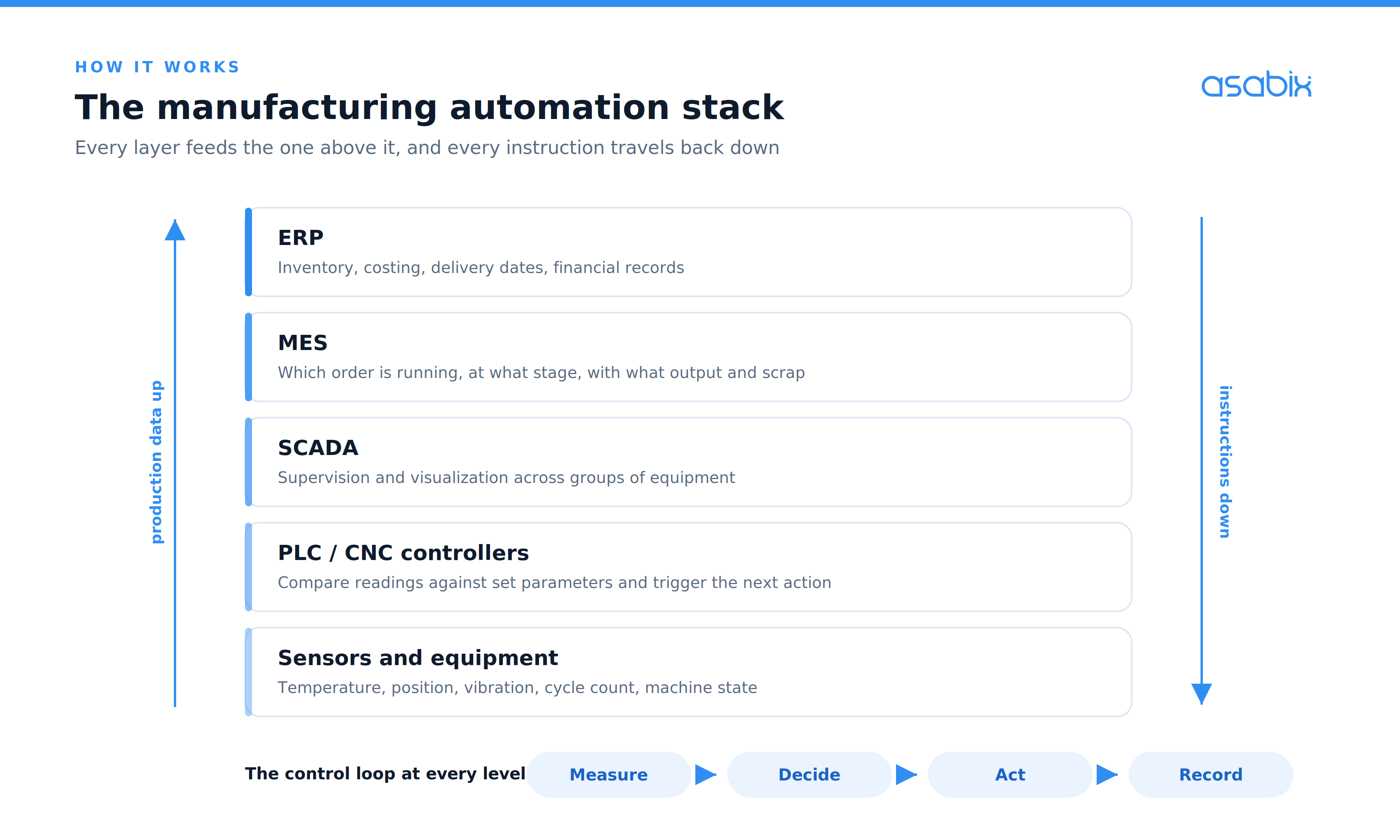
Most automation in manufacturing process design follows the same loop: measure, decide, act, record.
A sensor on a machine reads temperature, position, vibration, or cycle count. That signal reaches a controller, typically a PLC or a computer numerical control unit, which checks it against defined parameters and triggers the next action. A SCADA layer supervises groups of equipment, and above it sits a Manufacturing Execution System that translates machine activity into production terms: which order is running, at what stage, with what output and what scrap.
The final layer is business software. The MES passes confirmed production data to the ERP, which updates inventory, costing, and delivery dates. ERP here describes a function rather than a specific product: it can be a separate system, or a module that shares one database with the MES inside a single management platform. Data collection at every step is what makes the loop worth building, since real-time monitoring only creates value once the numbers reach the people making decisions.
Manufacturing automation vs. manual production
Manual production depends on individual skill and attention. Two operators running the same job produce slightly different results, and neither leaves a reliable record of what happened. Quality control turns into a sampling exercise, while management reporting waits on paperwork assembled after the shift.
Automated production narrows that variation. Cycle times hold steady, tolerances stay inside spec across shifts, and every unit carries a traceable history. Much of the operational efficiency gain comes from predictability, which is what lets a plant commit to delivery dates with confidence.
Manual work moves toward setup, maintenance, exception handling, and process improvement, where human judgment still outperforms any control system.
Types of Automation in Manufacturing
Industrial automation is usually grouped into four types, separated by how easily automation systems can be reconfigured for a different product.
| Type | Best suited to | Changeover effort | Typical equipment |
| Fixed automation | One product at very high volume | Line rebuild required | Transfer lines, bottling equipment, dedicated assembly lines |
| Programmable automation | Batch production of related products | Hours to days between batches | CNC machining centers, reprogrammable industrial robots |
| Flexible automation | High-mix production, smaller order quantities | Minimal, handled in software | Vision-guided robotic cells, quick-change tooling |
| Integrated automation | Whole-plant coordination | Coordinated centrally, may need a planned commissioning window | MES and ERP connected to equipment and material handling |
Most plants run a mix. The type you pick for the next process sets your cost per unit and how easily you can switch products later, and moving toward integrated automation is usually where digital transformation begins.
Key Technologies Used in Manufacturing Automation
Each technology below answers a specific production problem, so selection should start from the problem you need to fix.
MES and production management software
Equipment produces the data, and software is what makes it usable. A MES built around your own processes shows which parts are in progress, what remains in stock, and which lines are loaded or standing idle, in one place. The same platform can carry kanban boards, task assignment, routing schemes, and part drawings, with access rights set separately for managers, operators, design engineers, and technologists. Because it connects to orders and financial reporting, production planning stops being a separate record-keeping exercise run on spreadsheets.
Industrial robotics
Industrial robots handle welding, painting, palletizing, machine tending, and assembly, holding force, position, and cycle time steady in conditions that wear people down. Modern robotic systems identify parts by vision before gripping them, which lets mixed production lines run without dedicated fixtures for every variant. Adoption is now well beyond automotive: robot density in Western European manufacturing reached a record 267 units per 10,000 employees in 2024, with North America at 204 against a global average of 132.
AI and intelligent automation in manufacturing
Machine learning models read equipment data and detect the patterns that precede failure, which is what makes condition-based predictive maintenance possible. The same approach sharpens demand forecasting, production scheduling, and energy use. Intelligent automation in manufacturing also covers anomaly detection: a model that has learned the normal vibration signature of a press will flag a deviation days before anyone on the floor hears a difference.
Industrial Internet of Things
The Industrial Internet of Things connects machines, meters, and IoT devices into a shared network, and legacy equipment can be retrofitted with sensors where native connectivity is missing. This is the foundation for real-time monitoring of OEE, energy use, and machine state, which turns the Internet of Things into a usable planning input.
Machine vision
Cameras with automated inspection software check dimensions, surface defects, labeling, and assembly completeness at line speed. Machine vision applies quality assurance to every unit produced, with no drop in attention at the end of a night shift. Vision systems also feed robots the position data needed to pick unsorted parts.
Robotic process automation in manufacturing
Bottlenecks form in the office as readily as on the floor. Robotic process automation in manufacturing takes over repetitive administrative work: order entry, invoice matching, supplier documents, compliance reporting, and data transfer between systems that were never properly integrated. Payback tends to be quick, because the work is high-volume and rule-based.
Benefits of Automation in Manufacturing
Every benefit below should be tied to a metric you already track. A project without a measurable baseline is difficult to defend at budget time.
Increased productivity and efficiency
Automated equipment runs continuously at a fixed cycle time, which raises throughput without adding shifts. The larger gain usually comes from eliminating waiting. Once scheduling, material calls, and machine load are coordinated by software, idle time between operations drops sharply. Output per labor hour, machine utilization, and OEE are the figures that will show it.
Improved quality and consistency
Consistent process parameters reduce variation, and inline inspection catches defects at the station where they occur. Early detection protects margin, since scrapping a single component costs far less than scrapping the finished assembly it was built into. Scrap rate, rework hours, and customer complaint volume are the usual measures.
Cost reduction
The clearest savings sit in downtime. Siemens research published as The True Cost of Downtime 2024 put unplanned downtime at roughly 11% of annual revenue across the world's 500 largest companies, around $1.4 trillion, with an idle automotive line running to $2.3 million per hour. The same research recorded 25 downtime incidents per month at large plants against 42 in 2019, a drop it credits largely to predictive maintenance.
Workplace safety
Automation takes people out of repetitive lifting, high-temperature zones, press operations, and chemical handling. Recordable incidents, lost workdays, and insurance premiums are the direct measures. Beyond the obvious human argument, a safer plant is easier to staff, which carries real weight in a tight labor market.
Real-World Automation in Manufacturing Examples
The most useful automation in manufacturing examples are the ones where software and equipment work as a single system.
End-to-end production control with MES
The Artmash System is a manufacturer of agricultural equipment that ran seasonal production on spreadsheets and disconnected records. Our team built a centralized MES platform covering order intake, route sheets, multi-stage processing, synchronized warehouses, and logistics. Every production stage now sits in one transparent environment, accessible from tablets and phones on the floor, which gave the company the visibility it needed to plan around seasonal demand spikes.
Assembly and material handling
Robotic cells perform screwdriving, gluing, welding, and part placement, while automated guided vehicles move components between stations. Material handling often makes the best first project, since it carries less risk than touching the process itself. At BMW Group Plant Spartanburg, a Figure 02 humanoid robot spent ten months loading sheet metal parts for welding, supporting production of more than 30,000 BMW X3 vehicles.
Quality inspection
Vision stations verify dimensions and surface quality at full line speed, log every measurement, and reject faulty units automatically. That record then serves as evidence during audits and customer quality claims. Audi now runs AI analysis on around 1.5 million spot welds across 300 vehicles per shift at Neckarsulm, where staff previously ultrasound-tested a sample of roughly 5,000 welds per car.
Inventory and warehouse operations
Barcode and RFID scanning, automated storage systems, and WMS integration keep stock accurate with real-time data. Reliable figures prevent the stoppages that follow when a missing component surfaces only after the job reaches the line. Siemens' Amberg electronics plant shows the ceiling: about 75% of the value chain runs without human intervention, and roughly 17 million products ship each year, one every second of operation.
Automation in food manufacturing
Automation in food manufacturing centers on hygiene, traceability, and changeover speed. Filling, sealing, portioning, and packaging run on dedicated equipment, while batch and lot tracking supports recall readiness and HACCP documentation. Allergen changeovers become far easier to control once software enforces the sequence. Unilever's Sonepat factory reports an 86% reduction in product defects and 30% less food waste after its automation program.
Challenges of Implementing Automation
Adoption of automation across the manufacturing industry is uneven for good reasons. Four issues account for most stalled projects.
High implementation costs
Equipment is only part of the budget. Integration, tooling, safety compliance, facility changes, and training frequently equal or exceed hardware cost. Phased investment answers this: start with the area that has the clearest financial case, prove the return, then reinvest.
System integration
This is where projects most often stall. Machines speak different protocols, and packaged software rarely matches how a specific plant operates. When standard systems cannot cover your processes or require complex connections between equipment, ERP, and warehouse software, Manufacturing Software Development built around your existing workflows can offer a lower five-year total cost of ownership when packaged systems require extensive customization, licensing, and integration work.
Workforce training
New systems fail quietly when operators keep parallel paper records because they do not trust the screen. Training should be role-specific and delivered before go-live, with supervisors involved early enough to shape the interface.
Cybersecurity
Connected equipment expands the attack surface. Manufacturing accounted for 27.7% of all incidents tracked in the IBM X-Force Threat Intelligence Index for 2025, the fifth consecutive year it topped the list. Network segmentation between IT and OT, access control, patch management, and monitoring belong in the project scope from the start.
Future of Automation in Manufacturing
The trends in manufacturing automation below are already shaping investment decisions. Robots and CNC equipment keep improving incrementally, while the bigger shift in the future of automation in the manufacturing industry is how much decision-making moves into the control layer.
Collaborative robots
IFR figures put collaborative robots above 10% of all industrial robots installed worldwide, and that share has grown every year. Cobots are designed for collaborative applications and can often operate alongside people with reduced guarding, subject to a task-specific safety assessment. Combined with cloud-based automation software and subscription pricing, they let a company automate one cell at a time, which puts a first project within reach of plants that could never justify a traditional robot cell.
Digital twins
Digital twins mirror a line or product in software, letting engineers test layout changes, scheduling logic, and process parameters before touching physical equipment. Simulation shortens commissioning and lowers the risk of expensive rework after installation.
Smart factories
Smart factories connect equipment, planning, quality, and maintenance into one data environment where decisions rely on live figures. Additive manufacturing fits this model well, since 3D printing produces jigs, fixtures, and spare parts on site within hours. Augmented reality is finding steady use in maintenance and assembly guidance.
AI-driven planning and scheduling
Scheduling is where AI reaches production soonest. Models rebuild the plan when an order changes, a material delivery slips, or a machine drops out, then push the revised sequence to the floor within minutes. The planner's job shifts toward reviewing what the system proposes.
Connected supply chains
Production data is starting to move outward. Once schedules, capacity, and inventory are visible to suppliers and customers through APIs, promised dates become more reliable, and shortages surface early enough to act on.
Sustainability and energy reporting
Regulators and large customers increasingly ask for verified figures on energy and material consumption. The manufacturing systems that already track production are the natural place to collect them, which puts automation projects on the compliance roadmap as well as the efficiency one.
How to Implement Automation in a Manufacturing Facility
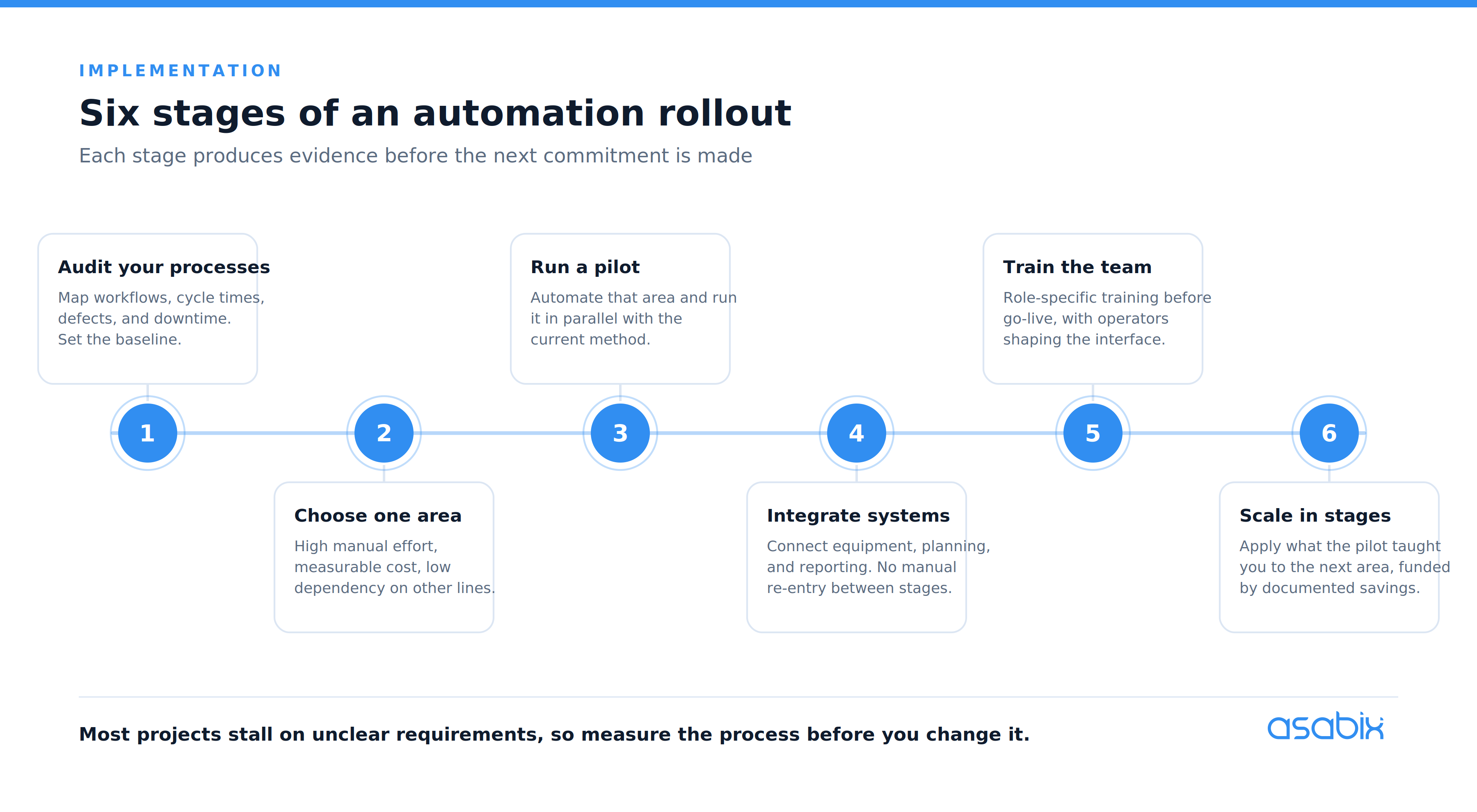
A structured sequence keeps risk manageable and gives you evidence before each new commitment.
- Audit your processes. Map current workflows, cycle times, defect rates, downtime causes, and manual data entry points, then set the baseline you will measure against. Most plants find their biggest loss somewhere unexpected.
- Choose one priority area. Pick a single process with high manual effort, measurable cost, and limited dependency on other operations. Repetitive material handling, inspection, or data entry usually qualifies.
- Run a pilot. Automate that one area, run it in parallel with the existing method, and compare results against the baseline. A pilot exposes integration problems and operator objections while the cost of changing course is still low.
- Integrate with your core systems. Connect equipment, planning, and reporting so data moves without manual re-entry. This is where custom MES software development fits: centralized control of production processes, automated data collection from equipment, monitoring of every stage, and management of work execution against the schedule.
- Train the team. Deliver role-specific training before go-live and keep experienced operators involved in refining the interface. Adoption depends on the people using it daily.
- Scale in stages. Apply what the pilot taught you to the next area, then the next, with each phase funding the following one through documented savings.
Wrapping Up
Automation in manufacturing has moved from competitive advantage toward practical necessity, pushed there by a shrinking pool of skilled labor and delivery expectations that keep tightening. The technology is proven, though the budgets behind it vary enormously: a robotic line, a machine vision station, and a first MES pilot belong to different orders of investment. The practical shift is in sequencing. A plant can start with one process, measure the result, and extend automation as each phase earns the next.
Preparation is what separates a project that pays back from one that stalls. Start with the process that costs you the most, measure it properly before anything changes, and prove the case on a single area before committing the rest of the plant. Unclear requirements are the most common reason automation projects lose momentum, and no amount of good hardware compensates for them.
Asabix builds the platforms that connect equipment, production data, and business processes into one system. Contact us to discuss what that would look like in your facility.
Let's discuss your project
Blog
#0000
Read more articles in our blog
What is PWA: Comprehensive Guide with Code Samples
26 Feb, 2024
Progressive Web Apps are web applications that bring best web and mobile features. PWAs are similar to native apps in functionality and can be used on any device with a web browser.
VIEW ARTICLE
-compress.jpg "Guide to Manufacturing Automation: Benefits, Applications, and Real-World Examples - Picture №10")
Outsourcing and outstaff: difference and features
20 Jul, 2023
Modern companies often have a need for fast and efficient development of software and other IT projects.
VIEW ARTICLE

Website Development Costs: What to Expect
08 Jan, 2025
Are you curious about the cost of creating a website? Discover how design intricacies, advanced functionality, and the type of site you envision can impact your budget.
VIEW ARTICLE
YII vs Laravel: What is the Best Option for Your Project?
02 Jan, 2024
Thanks to technological development, it is no longer necessary to write PHP code from scratch: there are many frameworks — ready-made models, "templates" for software platforms, among which Yii2 and Laravel became the most popular. In what their difference and which of the frameworks to choose for creating a product? We tell and compare the structures in this material.
VIEW ARTICLE
